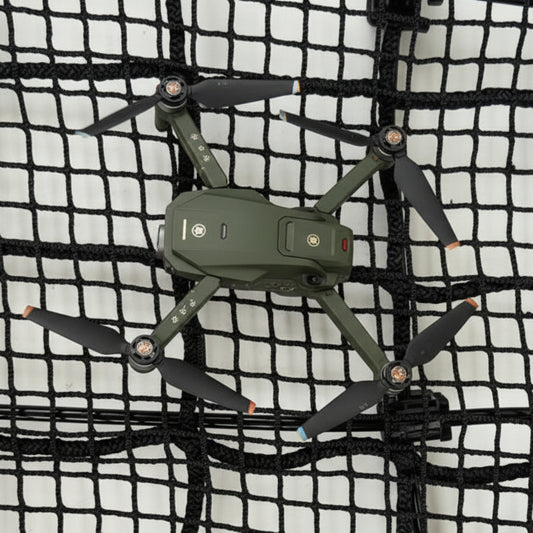
Barry offers a range of innovative textile products tailored to the Drone/Unmanned Aerial Vehicle (UAV) industry, serving both commercial and military applications. By collaborating with leading defense agencies, operators, and manufacturers, we continually advance our products and expertise to enhance the safety and security of people and assets. These lightweight, durable, and high-performance solutions increase payload capabilities, operational efficiency, and physical protection in demanding environments.
Barry solutions support both drone external load operations and passive protection against unauthorized or hostile drone activity. This includes lightweight underslung cargo systems, recovery systems, drone netting enclosures, anti-drone safety netting, and dielectric, non-conductive assemblies for energized environments.
Applications
- Lightweight underslung cargo systems, including synthetic slings, longlines, and cargo nets
- Recovery systems for downed aircraft and equipment
- Drone netting enclosures and containment systems
- Anti-drone safety netting
- Passive drone protection for sensitive or restricted areas
- Physical counter-UAS protection for critical infrastructure
- Military, defense, logistics, and humanitarian missions
- Dielectric, non-conductive slings and assemblies for energized environments
Drone external load solutions
Barry’s UAV external load products help transform aerial payload delivery across industries by enabling precise and efficient cargo transport for defense, logistics, emergency response, utility, and humanitarian missions. These advanced systems are designed for durability, safety, and reliability, even in challenging conditions.
Key innovations, such as the Lightweight Mini Cargo-Net and Lightweight Slings, provide efficient attachment and release capabilities, supporting rapid deployment or retrieval of critical payloads. These features are particularly valuable in disaster response scenarios, remote locations, and operations where access by conventional vehicles or manned aircraft may be limited.
UAV external load systems are transforming traditional logistics by offering safer, faster, and more cost-effective operations. Their ability to access hard-to-reach areas without the need for manned aircraft can help reduce operational risks and expenses. Smart technologies such as GPS-guided navigation and automated load release can further enhance mission precision and effectiveness when integrated into the overall UAV platform.
Passive drone protection and counter-UAS systems
Barry also develops textile-based systems for passive drone protection and physical counter-UAS applications. Unlike electronic counter-drone technologies that rely on detection, jamming, tracking, or active interception, passive protection systems use physical barriers that remain in place and operational at all times.
Barry anti-drone netting and drone containment systems are designed to support layered defense strategies by helping physically intercept, entangle, slow down, or contain selected UAV threats before they reach protected areas. These systems can be used around critical infrastructure, military sites, airports, logistics platforms, public areas, testing facilities, and other sensitive locations.
As a non-kinetic last line of defense, passive drone protection can complement existing detection and mitigation technologies while helping reduce collateral damage risks. These systems are especially relevant where continuous protection, low maintenance, outdoor durability, and physical standoff protection are required.
Why choose Barry?
By investing in Barry’s drone and UAV systems, organizations gain advanced textile-based tools that support aerial logistics, physical protection, and counter-UAS readiness. Whether for military, commercial, industrial, utility, or humanitarian purposes, these solutions help optimize operations and expand the possibilities of unmanned aerial systems.