

Barry Cordage
Cart

Cart

Contact Us
We can help you!

The Barry Centre of Excellence › Safety Alert

Safety Alert

Barry shall distribute and publish Safety Alerts to its customers, distributors and agents according to a Recall and Safety Alert procedure. Barry applies a strict procedure to ensure the safety of users of the products manufactured by Barry as well as products distributed by Barry.

Procedure:

As soon as we are informed of a situation that requires a recall, warning, special inspection or any Safety Alert, we will contact immediately the original buyer on record, using all the following means:

Barry will not discontinue the Safety Alert procedure until confirmation that all the original buyers on record have been informed of the Safety Alert.

In addition to the procedure described above, Barry will issue a public announcement of all Safety Alerts on this web page.

Visit it frequently or subscribe to our e-mail link to receive automatic Barry Safety Alerts.

Note: Facebook and Twitter fans, take note that all Safety Alerts will be posted immediately online.

For more information on Safety Alerts, please contact us, and we will be glad to provide details.

Important Safety Notice Concerning
Helicopter Longlines with Protective Jackets

To: All helicopter longline owners and users
Important Safety Notice Concerning Helicopter Longlines with Protective Jackets

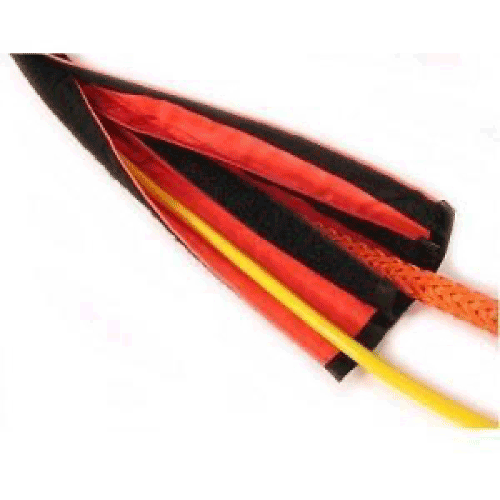
Barry was made aware of a recent incident involving a longline, which we believe should be communicated to the industry. This incident was reported to us by one of our test pilots who was flying with a synthetic longline protected by a hook-and-loop (Velcro) jacket made by another manufacturer.

Reported conditions:

Reported incident:

During a flight, while the load was still attached to the longline under the helicopter, the pilot looked in his mirror and could see the protective jacket flying close to the tail rotor, only attached to the top of the longline.He reported that the jacket probably opened (hook-and loop separated) near the mid-point of the longline, and with the wind, ripped open all the way to the bottom. The connection (snaps with hook-and-loop) of the jacket to that last portion near the bottom thimble could not resist and detached, resulting in the jacket trailing almost horizontally. Upon realizing the problem, the pilot slowed down and landed to fix the problem.No further damage was observed.

Recommendations:

Although this may be an isolated event, we believe this problem could happen with any longline with a fabric protective jacket, with either a hook-and-loop or zipper closure, if the closure system is defective or becomes worn or damaged. Hook-and-loop closure can lose much of its strength if it becomes dirty and wet or simply worn out from heavy use. An opened and unattached jacket could potentially fly in the tail rotor, with dangerous consequences.

As with any components of a longline (rope, thimbles, ring, electrical wire, etc.), the protective jacket must be inspected before each use and replaced if worn or defective. It should also be installed properly as per manufacturer’s instructions.

Flying speed when using a longline should be adjusted accordingly, and if the pilot perceives a problem, he should slow down immediately, visually identify the problem and land securely as soon as possible.

Please contact Barry if you have any questions with regards to this notice.

Petzl RECALL ALERT: ABSORBICA energy absorbers
and SCORPIO via ferrata lanyards

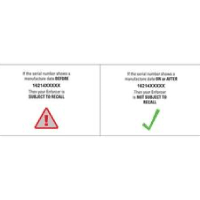
Safety product manufacturer Petzl recently launched a recall alert for all SCORPIO lanyards as well as a request for immediate self-inspection for all ABSORBICA energy absorbers.

If you are the owner or user of these products, immediately stop using their use and view Petzl’s notices. Each notice clearly identifies steps to be taken.

REQUEST FOR IMMEDIATE SELF-INSPECTION for all ABSORBICA energy absorbers

RECALL ALERT for inspection of all our SCORPIO via ferrata lanyards

Do not hesitate to contact us if you have any question regarding this alert.

Barry Barrel Sling - Special Safety Directive -
Product Safety Directive

To: All Barry Barrel Sling owners and users

This product safety directive is mandatory for all Barry Barrel Sling owners and users.

Please refer to the Special Prevention Inspection - Product Safety Directive Notice letter: Barry Barrel Sling - Special Safety Directive - Product Safety Directive

Background:
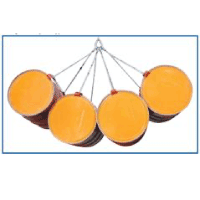
The Barry Barrel Slings are designed to carry steel barrels as external cargo by a helicopter.

These Barrel Slings consist of a continuous Dyneema® rope sling spliced in a pear-shaped ring, with 2 floating Crosby® barrel hooks:

Problem:

Crosby® Barrel Hooks:

Mandatory Inspection:

Because of the possible risk of losing a barrel during flight and the significance of this,

If defective barrel hooks are found (dimensions out of range), immediately contact Barry for further instructions.

Complete inspection:

Complete inspection of the entire Barry Barrel Slings should be carried out regularly.

Please contact Barry if you have observed any defect to your Barry Barrel Slings or if you have any questions with regards to this directive.

Additional information:

Due to further analysis, the Crosby Group (barrel hook manufacturer) recommends that their barrel hooks model S-377 are no longer to be used in transporting barrels under slung by helicopters as “there is a potential that the barrels could be bumped, causing the load in one leg to become slack”.

Although the Barry Barrel Sling design has features (continuous sling and rubber bands) which prevent the hooks from falling off, we are no longer supporting this product due to the quality issues of the hook which remain un-resolved.

As a preventive measure, Barry strongly recommends that all use made of the Barry Barrel Slings be stopped immediately for helicopter external cargo applications.

Barry Helicopter Long Lines - Special Prevention Inspection -
Product Safety Directive

To: All Barry Long Line Jacket owners and users

This product safety directive is mandatory for all Barry Long Line Jacket owners and users.

Please refer to the Special Prevention Inspection - Product Safety Directive Notice letter: Barry Helicopter Long Lines - Special Prevention Inspection - Product Safety Directive

Background:
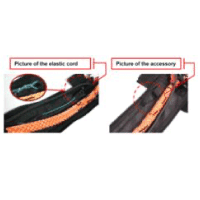
The Barry Long Line Jacket and End-Covers are designed to allow for some movement due to the elasticity of the line itself under load. The Jacket and End-Covers are joined together by either an elastic cord or an accessory cord.

Problem:

Elastic cord:

Accessory cord:

Recommendation:

Because of the possible risk of damaging the Long Lines and the significance of this,

As a result of flight testing and analysis, it has been determined that this modification will have no effect on the performance of the Jacket and End-Covers.

Complete inspection:

Complete inspection of the entire Barry Long Lines should be carried out regularly and in reference to: http://www.barry.ca/publication/helicopter-Long Lines-instructions-an.pdf

PenSafe Recall Notice 3730 Anchorage Connector

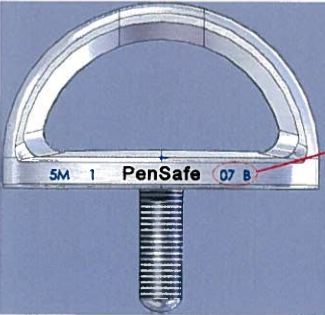
We were recently advised that a safety alert / recall notice was issued by PenSafe, for the recall of a batch of 3730 Anchorage Connectors manufactured in the latter part of 2007 and distributed by PenSafe inc. from June 2008 through June 2009.

Please refer to the PenSafe Recall Notice letter: PenSafe Recall Notice - 3730 Anchorage Connector

Note: PenSafe records indicate that this code of this product was not sold to Barry Cordage.

- Concerns Class Frontal-Fixed Rail Ladder (FRL)
Fall Protection Systems
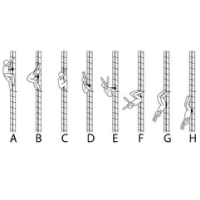
We were recently advised that a safety alert was issued by CSA, the Ontario Ministry of Labour (MLO) and the CSST.

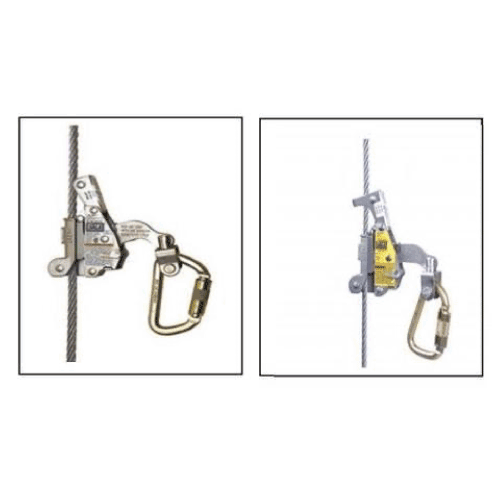
This alert concerns Class Frontal-Fixed Rail Ladder (FRL) Fall Protection Systems that are used on vertical access ladders. These systems are presently certified to CSA Standard Z259.2.1-98, Fall Arresters, Vertical Lifelines, and Rails.

A Class Frontal-Fixed Rail Ladder (FRL) [Class FRL] Fall Protection System is a permanently installed metal rail anchoring system used with an automatic fall arresting device called the trolley (carriage). The trolley travels freely on the rail, allowing the worker to use both hands while climbing up or down. Should the worker slip or fall, the device should lock, limiting the worker’s fall.

Some Class FRL Fall Protection System may not adequately protect workers who fall backward while connected to a vertical rail.

New requirements intended to address the safety concern are under development by the CSA Technical Committee for Fall Protection Systems. Until all affected products are tested for compliance to the new requirements, employers must take reasonable precautions to protect workers in these circumstances.

We invite you to read the following alerts :

CSA : http://www.csa-international.org/product_recalls/search/default.asp?articleID=9611&language=english

Ministry of Labour of Ontario: http://www.labour.gov.on.ca/english/hs/pubs/alerts/a26.php

CSST : french only (lien lettre ci-jointe)

B-Nets WARNING – Use only original components

B-Nets WARNING – Use only original components (PDF)

The legacy inventories of B-Nets from Vancouver Olympic Winter Games (VANOC) are dispersed across the country to various ski clubs and associations as part of the legacy.

A serious concern that we have with this situation is that sub-components (poles, clips, etc) may become mixed up with our systems currently in widespread use across all Canadian provinces and throughout the USA.

As you are probably aware, our installation guidelines do not allow for any substitution of components and the use of any other non-Barry component will void our warranty and may affect overall performance (ref. document: http://www.barry.ca/publication/barry-b-net-sys-spec-installation-guidelines-an.pdf).

Additionally, the installation method and design premise of our systems differs significantly from those acquired by VANOC for the 2010 Winter Olympic Games and of any other systems on the market today.

Specifically, we do not use a «scribed pole approach» (as used on the VANOC inventory and others), otherwise referred to as predetermined rated breaking points (PRBP), as we consider this to be dangerous.

Ref: Scribed B-Net Support Poles - A Dangerous Proposition... http://www.barry.ca/publication/barry-update-scribed-b-net-support-poles-a-dangerous-proposition-01-2009.pdf

The use of scribed poles on our Barry B-Net system is inappropriate and must be avoided.

Furthermore, our net tension is looser and our polycarbonate (PC) support poles are inserted at an angle of 10º uphill and 10º towards the race course which is different from the installation method of the VANOC B-Net inventory and of others.

Please contact us if you have any question concerning the Barry B-Net system.

The Barry team

Sign up for Barry Newsletter

Subscribe to Barry Newsletter and receive:

Subscribe now!